
Stop AIDS in Liberia
an HIV-focussed organisation with works to advance the health of marginalised groups including LGBT people.
Last updated: 7 October 2026
Same-sex sexual activity is prohibited under the Penal Law 1976, which criminalises acts of ‘sodomy’, broadly defined. This provision carries a maximum penalty of one year imprisonment. Both men and women are criminalised under this law.
Liberia is one of two countries in Africa (along with Ethiopia) that was never formally colonised. As such, its criminal law is of domestic origin. Attempts to strengthen the law against same-sex sexual activity have failed to materialise.
There is some limited evidence of the law being enforced in recent years, with LGBT people being occasionally subject to arrest, often after reporting incidents in which they were victims of assaults. There have been consistent reports of discrimination and violence being committed against LGBT people in recent years, including assault, harassment, intimidation, and social exclusion.
It was reported that on 18 July a Bill entitled ‘Anti-Homosexuality Law of Liberia 2024’ was read on the floor of the House of Representatives. On 19 July, the House of Representatives reportedly instructed a joint committee on Gender, Health and Judiciary to review the Bill, which would explicitly criminalise ‘homosexuality’ and ‘aggravated homosexuality’. The Bill was said to be a ‘copycat bill’ based on similar laws passed in Uganda and Ghana. As of October it appeared that the law had not been passed.
In November, a bill was introduced that would amend the Penal Code to criminalise ‘same-sex practices’. It was not discussed before the legislature went on recess in December.
A bill that would further criminalise ‘homosexual behaviour’ was passed by the Liberian Senate and roundly criticised by the Office of the High Commissioner for Human Rights. Then President Sirleaf said that while she would not oversee the decriminalisation of same-sex sexual activity, she would also veto any new ‘anti-homosexuality’ law. The bill was not adopted.
We’ve got certain traditional values in our society that we would like to preserve.
The US Department of State reported that the law was enforced, and documented a case in January in which national police charged two assault victims of ‘sodomy’ instead of investigating allegations against them.
All US Department of State reports from 2016 to 2020 did not report any instances of the law being enforced.
A civil society submission to the UN Human Rights Committee reported a number of cases of arrest of LGBT people under the voluntary sodomy law in the preceding years, including five instances from September-October 2016.
The US Department of State report recorded that a victim of assault was arrested due to his sexual orientation after seeking police assistance. Furthermore, in October an LGBT organisation reported that several individuals were arrested and accused of sodomy, one of whom had been arrested after reporting to the police that he had been robbed.
The US Department of State report noted that the law did not prohibit discrimination against LGBT people, who faced discrimination in access to education, employment, and services. There were reports of harassment based on LGBT status, and hate speech was a persistent problem perpetuated by government and religious figures, including in that year’s election campaign. LGBT people were reluctant to report incidents to police due to fear of reprisal. While there were no legal restrictions on LGBT advocacy, but few people engaged in these activities due to fear of abuse.
A young gay man was lured by a fake social media account posing as a senator offering him a job, then ambushed by a group of homophobic assailants who robbed and beat him.
The US Department of State cites the NGO, Lesbian and Gay Association of Liberia, which reported 14 cases of abuse, including mob violence and assault in 2022. Furthermore, in July local radio reported that residents of Sinoe County threatened to kill “anyone involved with homosexuality.” However, the report also cited activists as noting improvements in police treatment and protection of LGBT people following training.
In August, a journalists’ home was attacked allegedly due to his reporting on LGBT issues. After reporting the incident, the journalist was arrested for allegedly ‘sodomising’ the attacker. He was released following intervention of lawyers and human rights activists.
The US Department of State reported that three people were attacked in Karloken City during the year on account of being suspected of being transgender.
In May, three men were beaten on suspicion they were gay in the Gobachop community of Paynesville. Three days later police arrested two suspects, but a local NGO reported that they were released upon order of an unnamed influential person.
In June, a teen student at the St. Matthew United Methodist School in New Kru Town was expelled for “cross-dressing”.
The US Department of State report found that LGBT people were subjected to assaults, harassment, and hate speech. The community was reluctant to report incidents to police due to stigma and faced difficulty accessing justice, though in October two members of a group known for anti-LGBT assaults were arrested.
In April, a report was released by the UNOHCHR and UNDP which documented the widespread negative public attitudes, violent attacks, intimidation, and social exclusion of the LGBT community in Liberia.
In November an HIV testing centre was stormed and a number of LGBT people were attacked. Approximately 10 people were injured and five hospitalised, including one being stabbed.
In January, a group harassed and assaulted five LGBT people, tearing off their clothes and stealing their money and belongings.
In November, an NGO promoting LGBT rights was denied registration by the Liberia Business Registry for “activity which is not allowed in Liberia.” The registration request continued to be denied.
In August, the Liberia Council of Churches ministers reportedly signed a statement warning individuals that the recent Ebola outbreak in the country has been caused by immoral acts such as homosexuality. The statement was signed by over 100 ministers, including the leading Catholic official in the country, Archbishop Lewis Zeiglier.
A December report by Human Rights Watch point to many instances of discrimination and violence against individuals who are perceived to be gay. As in Uganda following the passage of the (now quashed) Anti-Homosexuality Act, individuals living in Liberia reported an increase in discrimination and violence since the introduction of two bills to further criminalise LGBT individuals in 2012. As one individual reported: “Before these laws, LGBT persons had few problems, they were able to come and go freely, even had gay parties without interference from the public. There was public harassment here and there but hardly ever anything to the degree that it is experienced today. Since the [proposed] laws were introduced, SAIL has had more and more cases of public harassment, violent attacks, families disowning their children, and even evictions from rented spaces”.
an HIV-focussed organisation with works to advance the health of marginalised groups including LGBT people.
a local organisation working to advance the rights of transgender people.
Sierra Leone criminalises same-sex sexual activity between men. Sentences include a maximum penalty of life imprisonment.
Guinea criminalises same-sex sexual activity between men and between women. Sentences include a maximum penalty of three years’ imprisonment and a fine.
Ghana criminalises same-sex sexual activity between men. Sentences include a maximum penalty of three years’ imprisonment.
The country profiles on the Human Dignity Trust’s website are developed through a combination of in-house expertise and research, including monitoring media reports; sourcing reports from partners and stakeholders; and reviewing reports from governments and other human rights organisations.
We go to great lengths to ensure that, to the best of our knowledge, the information provided on our website is correct and up to date. If you believe that any information on our website is inaccurate, you may bring this to our attention by e-mailing [email protected].
Information on this website is provided for general use only and should not be relied on as a definitive position on the law as it applies at any given time. No liability can be accepted for any use of the information in this website and/or links from it.
Over 60 countries still criminalise LGBT people. Together, we can bring this number down. A donation today will help continue our vital support for LGBT people and governments seeking to change laws around the world.
Donate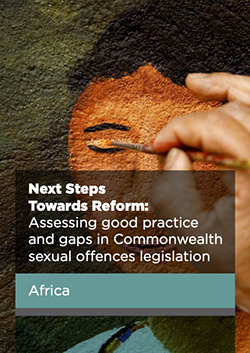
This report examines the status of sexual offences legislation in Commonwealth Africa, assessing good practice and identifying where there are gaps in protection, with a particular focus on women, children, LGBT+ people and people with disability.
The Trust will provide technical legal & communications assistance to Commonwealth governments
To mark LGBT History Month 2022, the Trust' new timeline chronicles the evolution of the criminalisation (and decriminalisation) of same-sex activity.
Join our newsletter to receive regular updates about decriminalisation efforts around the world, including breaking news on key legal cases, hot off the press reports, invitations to events and messages from our Chief Executive.