
Sierra Leone
Sierra Leone criminalises same-sex sexual activity between men. Sentences include a maximum penalty of life imprisonment.
Last updated: 2 October 2026
Same-sex sexual activity is prohibited under the Penal Code 2016, which criminalises ‘indecent acts or acts against nature’. This provision carries a maximum penalty of three years’ imprisonment and a fine. Both men and women are criminalised under this law.
Guinea has criminalised same-sex sexual activity since at least its 1998 Penal Code. In 2016 a new Penal Code was adopted, in which the criminalising provision was maintained and substantively unchanged.
There is limited evidence of the law being enforced in recent years, with LGBT people being occasionally subject to arrest. Reports of discrimination and violence being committed against LGBT people in recent years are rare due to widespread social stigma which prevents them from reporting incidents.
In 2016, a new Penal Code was adopted. This Code maintained the criminalising provisions found in the 1998 Penal Code.
Civil society reporting to the latest Universal Periodic Review of Guinea noted that since the 2021 coup, law enforcement have made repeated raids on places where LGBT meet and have made arrests. Most arrests result in bribes being paid to avoid formal legal proceedings, and cases are usually registered under other laws.
Freedom House’s Freedom in the World report asserts that although the law is rarely enforced, LGBT people have been arrested on lesser charges in connection with their identity. It is not stated which laws are used in this context.
ILGA World’s Our Identities Under Arrest report recorded around 15 examples of arrests of LGBT people. While details are often scare, none of these cases appear to have resulted in prosecution, with many being resolved through the payment of bribes.
The US Department of State reports, including 2023, have not found any examples of prosecutions in recent years, although it notes that a unit within the Ministry of Security exists to investigate ‘morals offences’, including same-sex sexual activity. The reports mention that LGBT individuals face harassment and persecution by law enforcement officials and often pay bribes in order to avoid arrest.
Amnesty International noted in a report on Guinea that at least three people were arrested due to their sexual orientation in 2015-2016, and two were sentenced to three months’ imprisonment.
The 2013 US Department of State report noted that authorities allegedly arrested ‘cross-dressing men’ in nightclubs on public nuisance charges. It is not clear whether these arrests resulted in prosecutions.
Civil society reporting to the latest Universal Periodic Review noted the impact of criminalisation, including that LGBT avoid seeking HIV treatment, and prejudice and discrimination are among the main obstacles to education and employment for LGBT people. LGBT people who are open about their identity are subjected to violence, including stone throwing and public insults.
The US Department of State notes that “LGBT people face arbitrary arrest, violence, and harassment by security forces who accused them of disrupting the social order.” LGBT people face stigmatisation, societal discrimination, and sexual assault due to their sexual orientation. Trans people were subjected to “compassionate incarceration” to “protect” them from community violence.
A report by the Immigration and Refugee Board of Canada noted an incident in which two young people who wore t-shirts supporting LGBT rights were attacked and then arrested by police.
Sierra Leone criminalises same-sex sexual activity between men. Sentences include a maximum penalty of life imprisonment.
Liberia criminalises same-sex sexual activity between men and between women. Sentences include a maximum penalty of one year imprisonment.
The Gambia criminalises same-sex sexual activity between men and between women. The gender expression of trans people is also criminalised. Sentences include a maximum penalty of life imprisonment.
The country profiles on the Human Dignity Trust’s website are developed through a combination of in-house expertise and research, including monitoring media reports; sourcing reports from partners and stakeholders; and reviewing reports from governments and other human rights organisations.
We go to great lengths to ensure that, to the best of our knowledge, the information provided on our website is correct and up to date. If you believe that any information on our website is inaccurate, you may bring this to our attention by e-mailing [email protected].
Information on this website is provided for general use only and should not be relied on as a definitive position on the law as it applies at any given time. No liability can be accepted for any use of the information in this website and/or links from it.
Over 60 countries still criminalise LGBT people. Together, we can bring this number down. A donation today will help continue our vital support for LGBT people and governments seeking to change laws around the world.
Donate
This report examines the status of sexual offences legislation in Commonwealth Africa, assessing good practice and identifying where there are gaps in protection, with a particular focus on women, children, LGBT+ people and people with disability.
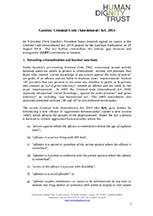
Human Dignity Trust's briefing note details how the new Criminal Code of the Gambia (2014) further criminalise lesbian, gay, bisexual and transgender (LGBT) individuals.

The Trust will provide technical legal & communications assistance to Commonwealth governments
Join our newsletter to receive regular updates about decriminalisation efforts around the world, including breaking news on key legal cases, hot off the press reports, invitations to events and messages from our Chief Executive.